
Does Insulation Save More Carbon Than It Creates?
It’s a fair question. Insulation has to be manufactured and transported, and each of those steps has a carbon impact. If more insulation is added to a home, its upfront embodied carbon will increase. But that’s only the starting point!
Once installed, insulation reduces the amount of energy required to heat, cool, and generally operate the home. If the energy is being produced by burning fossil fuels, then the reduction in energy consumption provided by the insulation is saving operational carbon. Those operational carbon savings accumulate every year, for the life of the building, while all of the insulation’s embodied carbon has already been accounted for before the homeowner moves in.
A study by Building Knowledge Canada (2026, link) found that, across the homes and climates modelled, the additional embodied carbon associated with higher insulation and airtightness levels was offset by operational carbon savings in approximately 3.1 to 5.1 years. In other words, the initial carbon investment was recovered relatively early in the life of the home. And the operational carbon savings continued after that point.
Embodied carbon and operational carbon are connected
Embodied carbon accounts for the emissions associated with the materials and processes used to construct a building. It begins with raw material extraction and manufacturing, then can extend to transportation, construction, maintenance, replacement, and eventual end-of-life treatment. At this time, researchers have a very good understanding of the embodied carbon of manufacturing but not as well with the rest of the embodied carbon cycle.
Operational carbon is produced as the completed building is used while conditioning the interior space. In a home, it is largely connected to the energy required for energy use like heating, cooling, ventilation, lighting, hot water, and appliances.
Insulation is unique among building materials. Insulation is specifically installed to reduce operational energy of the building. As such, insulation has embodied carbon to manufacture it, but it saves operational carbon. A steel beam by contrast, is required to support the building. It also has embodied carbon to manufacture it but there is no savings in operational carbon provided by the steel beam. To talk only about the embodied carbon of the insulation without talking about the operational carbon savings provided by the insulation does a dis-service to the insulation.
A lower upfront number does not necessarily produce the lowest-carbon building. If using less insulation causes the home to consume more energy every year, the apparent embodied carbon saving at construction can be overtaken by higher operational carbon emissions.
What the study actually compared
Building Knowledge Canada prepared the NAIMA Canada Preliminary Carbon Study for Insulation to assess the long-term operational-carbon benefits of insulation in low-rise housing.
Five Part 9 residential archetypes were modelled: an end-unit townhome, a mid-unit townhome, a two-storey single-detached home, an end-unit stacked townhome, and a mid-unit stacked townhome. For the stacked designs, both the upper and lower units were included so that the foundation, slab, and roof were captured in the results.
The homes were placed in two Canadian climates: Ottawa in Climate Zone 6 and Edmonton in Climate Zone 7A.
Several performance packages were tested, including NBC 2020 Performance Tier 1, Tier 1 with the insulation removed, full Tier 5, Tier 1 with Tier 5 insulation levels, and Tier 1 with both Tier 5 insulation and airtightness levels.
The last comparison is particularly useful. The mechanical equipment and basic Tier 1 design were retained while the insulation and airtightness values were increased. This made it possible to examine what happened when the building enclosure was improved without changing the entire house.
Annual energy use and operational carbon were modelled in HOT2000 using the Volta SNAP platform. The operational carbon results used emissions factors from Canada’s 2023 National Inventory Report. The product-stage embodied carbon of the building materials was calculated using Natural Resources Canada’s Material Carbon Emissions Estimator, commonly known as MCE2, with environmental product declaration (EPD) data for the insulation products included in the analysis.
What happened in an Ottawa single-detached home?
The Ottawa single-detached model provides a clear example.
The Tier 1 home used 96.60 gigajoules of energy annually and produced 3.92 tonnes of operational carbon per year. When that same basic home was modelled with Tier 5 insulation and airtightness levels, annual energy consumption fell to 76.93 gigajoules and operational carbon fell to 2.90 tonnes.
That is an annual operational-carbon reduction of 1.02 tonnes.
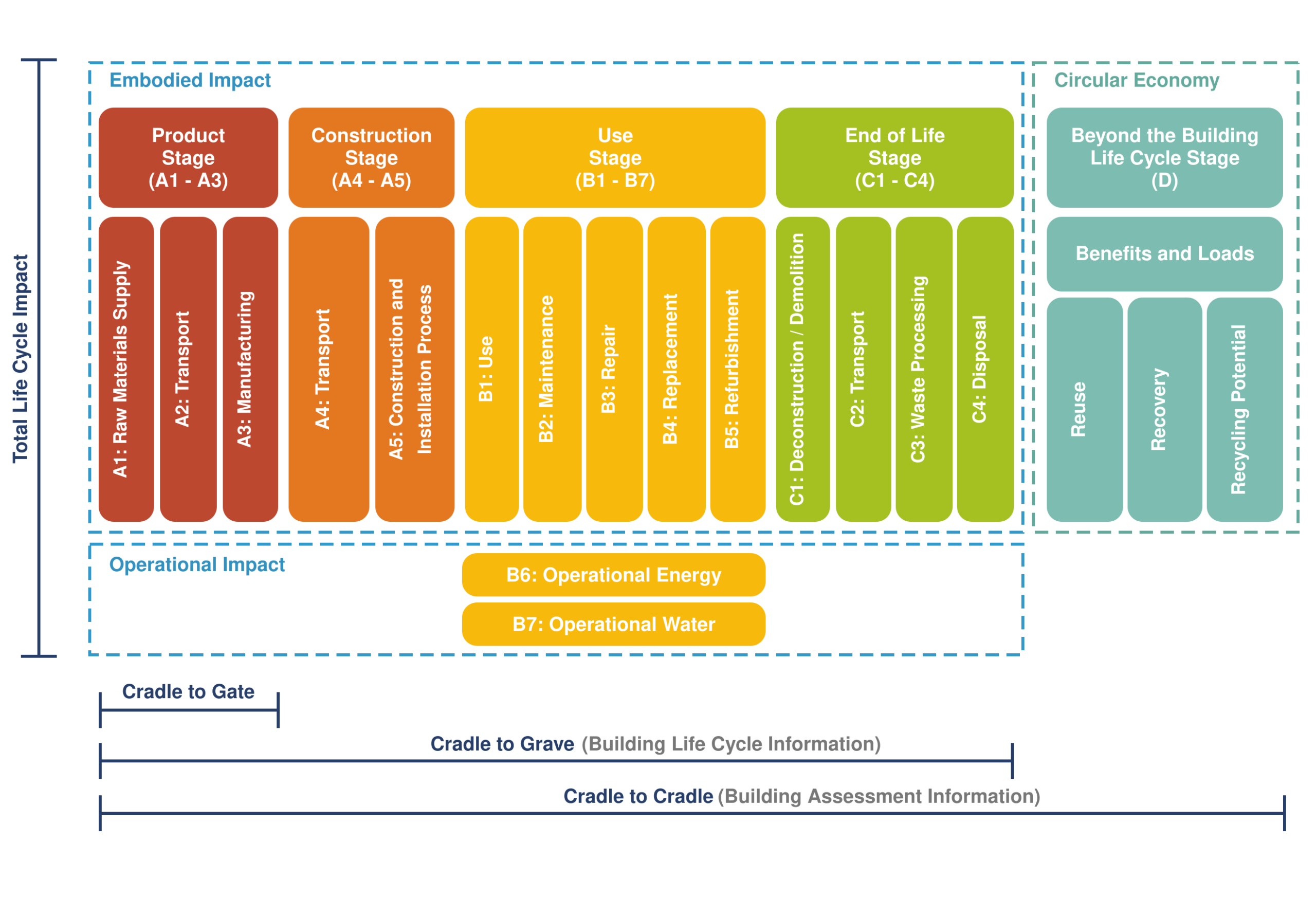
The A1–A3 (see diagram) embodied carbon increased from 26.36 tonnes to 31.56 tonnes, a difference of 5.20 tonnes. Based on the annual operational savings, the additional product-stage carbon was recovered in approximately 5.1 years.
The building enclosure would continue performing well beyond year five. Over a 75 or 100 year building life, that difference matters far more than a snapshot taken on the day construction ends.
The results were not limited to detached homes. In the Ottawa mid-unit townhome, for example, annual operational carbon fell from 3.08 to 2.35 tonnes when Tier 5 insulation and airtightness were added to the Tier 1 design. A1–A3 embodied carbon rose from 22.90 to 26.14 tonnes. The added embodied carbon in that case was offset in roughly four and a half years.
A short carbon-payback period across the models
The study uses the term “carbon payback period” to describe the time required for the annual operational carbon savings to offset the added embodied carbon emissions from putting insulation in the enclosure.
Across the archetypes, the payback period ranged from approximately 3.1 to 4.0 years in Edmonton and from approximately 3.7 to 5.1 years in Ottawa.
The difference between the two locations is not surprising. Climate, heating demand, fuel use, electricity emissions, and housing form all affect the result. An end-unit townhome has more exterior surface area than a mid-unit townhome. A stacked unit interacts differently with the outdoors than a detached house. Edmonton and Ottawa also have different heating demands.
Even with those differences, the same general pattern appeared across the models: increasing insulation created a minimal upfront carbon cost, but it also produced recurring operational carbon savings that offset that cost within the first few years of the building life.
The study found annual operational carbon reductions ranging from 0.57 to 2.02 tonnes of carbon dioxide equivalent, depending on the archetype and climate. The additional embodied carbon associated with the insulation upgrades ranged from 2.11 to 6.17 tonnes.
Those ranges are more informative than a single universal number. The carbon effect of an insulation upgrade will not be identical in every home, but it can be calculated in relation to the home’s design, location, and energy use.
Why an upfront-only assessment can give an incomplete answer
Embodied carbon policy is often focused on emissions released before a building is occupied. There is a reason for that urgency: upfront emissions enter the atmosphere now, while operational savings occur over time.
Still, an upfront-only assessment is incomplete when a material directly affects the building’s future energy demand.
Consider the Ottawa detached model again. Looking only at A1–A3 emissions makes the higher performance enclosure appear worse because its total increases by 5.20 tonnes. Looking only at operational carbon misses the fact that additional material was required to produce the annual savings. Neither number tells the full story on its own.
Placed on the same timeline, however, the relationship becomes clear. There is an initial increase, followed by a 1.02 tonne annual reduction. The two lines cross after approximately 5.1 years. Beyond that point, the improved enclosure has produced a net carbon benefit relative to the Tier 1 enclosure model.
This does not mean embodied carbon should be dismissed. It’s still a very important part of the story. But at the same time, a building material or component should be assessed in relation to the work that component performs.
For insulation, this work continues every winter and summer, 24/7.
Looking beyond the product stage
The study’s main embodied-carbon calculations used MCE2, which assesses cradle-to-gate emissions covering lifecycle stages A1 to A3 (i.e. the manufacturing stage of a product). These stages include raw material supply, transportation to the manufacturer, and manufacturing.
Building Knowledge Canada also developed higher level estimates to look further. Because residential modelling tools do not yet consistently account for construction stages A4 and A5, assumptions informed by external research were used to estimate them. The analysis also considered temporary propane heating during construction, recognizing that winter construction practices differ between Ottawa and Edmonton.
Separate scenarios examined future replacement of shingles, windows and space conditioning equipment. In those scenarios, shingles and heating equipment were replaced every approximately 20 years, while windows were replaced approximately every 25 years. Insulation was not treated as a regularly replaced product, as it generally does not need to be replaced over the life of the building.
That distinction is important. Furnaces, heat pumps, windows, and roofing may be replaced several times over a long building life. Insulation installed within the initial build of the enclosure can remain in service, constantly reducing heat flow through each equipment replacement cycle and just through general life in the home.
These additional scenarios do not turn a preliminary study into a complete whole building lifecycle assessment. They do, however, show why the length of the study period and the expected service life of building components matter.
Why this matters for new construction
There is also a practical reason to consider insulation early: the building enclosure is difficult to revisit after construction.
A furnace or heat pump can usually be removed and replaced without opening the exterior walls. Increasing wall insulation later may require removing interior finishes or exterior cladding. Foundation upgrades can involve excavation, and work may become harder once the building is occupied.
Prioritizing insulation and airtightness during initial construction can avoid a costly and disruptive retrofit later. It also means the operational savings begin immediately rather than years after the home is built.
That has implications beyond carbon. Lower heating and cooling demand can make a home more comfortable, reduce the impact of energy price changes, and help the indoor temperature remain stable during very hot or cold weather or extreme weather events. It can also reduce the capacity required from mechanical equipment and the demand each home places on the energy system during peak periods.
What this means for building policy
The study was developed in the context of Canada’s work on embodied greenhouse gas (GHG) emissions and the 2030 Model National Building Code. As that work advances, the treatment of longer term energy efficiency measures deserves careful attention.
A policy that rewards the lowest possible upfront embodied carbon without recognizing operational consequences could encourage less material use while producing homes that need more energy. That would lower one part of the carbon ledger by increasing another.
The better objective is to reduce total carbon emissions over the building’s life. Doing that requires the embodied and operational sides of the equation to be examined together, with enough detail to account for climate, housing form, energy sources, equipment replacement, and the service life of the materials involved.
The study’s central finding is hard to ignore: in the homes modelled, the carbon associated with higher insulation and airtightness levels was not a decades long debt. It was offset in approximately three to five years.
The full carbon story
All consumer goods and building materials are under the microscope for embodied carbon. We’re at a turning point in our industrial history where we’ve got to look hard at the carbon we generate. Yes, insulation has embodied carbon, like all other building materials. The Building Knowledge study does not attempt to hide that fact; it measures it, and also measures what happens next.
Across five housing archetypes in Ottawa and Edmonton, higher insulation and airtightness levels reduced annual operational emissions enough to recover their additional embodied carbon within a small fraction of the expected life of a home. From that point forward, the enclosure continued to reduce energy demand.
Looking only at upfront carbon would capture the initial cost while leaving out most of the return. For a material intended to perform for decades, that is not a complete accounting.
The question is not simply how much carbon is embodied in insulation at the time of construction, but how that initial impact compares with the energy use and emissions the insulation helps avoid throughout the building’s life. Only by considering upfront and operational carbon together can we determine which choices produce the lowest carbon home over time.